
Amazon Work From Home Jobs Feel Tempting? That's a Stuck Signal, Not a Solution
You've been searching amazon work from home jobs. Maybe with a browser tab still open on the business you built. I want to say gently what you already half-know: that search is a symptom, not a plan.
The pull toward a big-name remote paycheck usually shows up when your own thing has stalled. You wanted freedom, you started building it, and the money and the space you were promised haven't arrived. So the idea of a steady deposit from a company that will never go under starts to look like relief. I get it. But the ache isn't a job problem. It's a signal that something in what you built stopped working - and swapping it for a shift schedule won't fix it.
What are Amazon work from home jobs, really?
Amazon work from home jobs are remote roles - customer service, data entry, virtual support, some corporate positions - where you're an employee or contractor doing set hours for a set wage. That's the honest definition. You trade time for money on someone else's terms, from your kitchen table instead of a cubicle.
Nothing wrong with that if it's genuinely what you want. But notice the shape of it. You already left that trade once, on purpose, to build something of your own. The reason a remote Amazon role glows so warmly right now is that it promises certainty - and certainty is exactly what your stuck business has stopped giving you.
Worth knowing before you romanticise it: Amazon's much-publicised "work from home" push has largely reversed. In 2025 the company mandated a full five-day return to the office for corporate staff, per Reuters. The genuinely remote roles are fewer, more competitive, and more disposable than the search volume suggests. The dream version and the real version rarely match.

Why does a steady paycheck feel so tempting right now?
Because uncertainty is exhausting, and you've been carrying it alone. When your own income is lumpy and the growth you expected hasn't landed, a fixed wage feels like putting the weight down.
I know that feeling from the inside. My cake business, Cakes by Karen, started as an accidental Facebook page when my daughter was eight weeks old - a hundred followers and nine orders in the first 48 hours. It grew to a commercial kitchen, around 50,000 followers, multiple six figures. From the outside, success. From the inside, a prison. I was working 70 to 80 hour weeks and almost working for free as copycats undercut me on price.
There were nights I'd have taken a boring salaried job in a heartbeat, just to stop the churn. That wasn't a sign I should quit building. It was a sign the model I'd built was broken. Those are very different problems, and they need very different answers.
The real reason your business stalled (and it isn't the paycheck)
Here's the part almost nobody tells you: most stuck freedom businesses aren't stuck because the owner didn't work hard enough. They're stuck because the thing was built to grow only by adding more of you.
More hours. More clients. More custom work. More things to manage. My cake business scaled beautifully - and every extra dollar cost me more of my life, because the whole model ran on my two hands. That's not a business, that's a job you can't call in sick to.
If you recognise that, the fix isn't a bigger effort or a safer employer. It's usually the opposite - fewer moving parts. I've written before about why your stuck business has too many moving parts, and it's the pattern I see most often in women who are earning something but exhausted by it. The complexity you added to grow is the exact thing capping you.
So before you fill in an Amazon application, ask the harder question: is my business failing me, or did I build the wrong version of it?
How do you tell a broken model from a broken effort?
This is the diagnosis worth doing, because it changes everything about your next move.
A broken effort looks like inconsistency - you start and stop, you avoid the money conversations, you tinker instead of shipping. That's fixable with focus, and honestly, for years my own inconsistency was the problem. I have ADHD, diagnosed in 2023, and I chased every shiny thing for a long time. The freedom only came once I finally stuck to one thing. If that's you, the answer isn't a new job, it's building a business that works with how your brain actually runs instead of fighting it.
A broken model looks different. You are consistent. You are working. And you're still trapped, because the maths of the thing means the only way up is more of you. That's what a remote paycheck secretly rescues you from - not the work, but the design flaw. Except an Amazon role doesn't fix the flaw, it just hands the power to someone else.
Ask yourself honestly which one you have. Because if it's the model, a job will feel like relief for about three months and then feel like a cage again - only this time it's not even yours.

What to do instead of chasing amazon work from home jobs
If the tug toward amazon work from home jobs is really a tug toward stability, then let's get you stability the right way - inside something you actually own.
Here's where I'd start:
- Cut before you add. Look at everything your business does. Most of it isn't earning. Kill the offers, platforms and admin that drain hours without moving money.
- Find the one thing that pays. Nearly every stuck business has a single offer doing most of the work. Do more of that and less of everything else.
- Break the "only me" link. Where does the business stop the second you stop? That's the exact spot to fix - with a product, a system, or a way to serve more people without more hours.
- Design for the income you actually need, not the vanity number. Sometimes stability is closer than you think. You just built it in the wrong shape.
When Cakes by Karen became a prison, my fix wasn't a job. It was a total redesign of my life. The turning point was my three-year-old's Mother's Day painting: "My mum's favourite thing to do on the weekend is sleep." That was a smack in the face.
We sold a lifetime of possessions for $10k, left Australia in January 2016 deliberately homeless, and I've been location-independent ever since - 60-plus countries, 80-plus house sits saving over $250,000, kids world-schooled along the way. None of that came from picking safety. It came from fixing the design.
But isn't a guaranteed wage the sensible choice?
It feels sensible. It often isn't, once you've already tasted running your own thing.
The 13,000-family online community I'd built got deleted by Facebook overnight. Gone, no warning. That's why I never build only on rented land - and it's also why "guaranteed" is a slippery word. A big company's remote job isn't guaranteed either. Ask anyone told in 2025 to be back at a desk five days a week.
Your own business, built right, is the more durable asset. Not because it's risk-free, but because the control stays yours. The question was never whether you should have a business - you already know that. The question is whether you'll fix the one you have or abandon it right before it was going to work.
Frequently Asked Questions
Are Amazon work from home jobs legit?
Yes, Amazon does hire for some genuinely remote roles, mostly in customer service and corporate functions, though many have shifted back to office-based since 2025. Watch for scam listings that ask for upfront fees - real Amazon jobs never do.
How much do Amazon work from home jobs pay?
Remote customer service roles typically sit in the modest hourly range, with corporate positions paying more. The point for you isn't the number - it's that you're back to trading fixed hours for a fixed wage, which is the trade you already chose to leave.
Should I take a work from home job while my business is stuck?
Only if you've honestly diagnosed why it stalled first. A job can buy breathing room, but if your business is stuck because of a broken model, a paycheck just delays the fix and hands your control to an employer.
Why do I keep looking at jobs when I wanted to be my own boss?
Because uncertainty is tiring and a steady wage looks like rest. The craving is usually for stability, not for a boss - and you can build that stability inside a business you own, once you fix what actually broke.
If any of this landed, the honest next step isn't an application, it's a diagnosis. Work through The Reality Check to pin down exactly why your business stalled and what to change - so the freedom you started building actually shows up, instead of getting traded away for someone else's payroll. You didn't come this far to go back to the kitchen table on someone else's terms.

Karen King, Founder of The Escapepreneur® & ESC Hub
Karen King is the founder of The Escapepreneur® and the woman behind the term. After burning out running a six-figure cake business in Australia, she sold everything, left the country, and spent the last 10 years building a freedom-based business across 60+ countries. On No More Somedays, she writes for the online business owner who is smart, tired, and done with waiting for someday to arrive. Honest, practical, zero hype.
Take the Reality Check
Working hard but going nowhere? Answer 10 quick questions and find out what's really been holding you back — and where to start.
Start My Reality Check →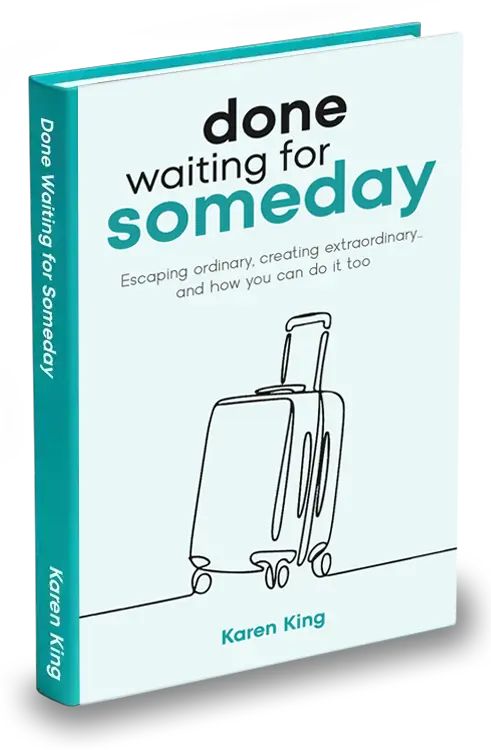
Done Waiting for Someday
The step-by-step path to turning the business you have into the freedom you want.
Get the book →Join The Escape Club
Support, accountability and a room full of people building freedom-first businesses alongside you.
Join the Club →