
A Membership Business Might Be the Freedom Model You've Been Missing
You've been at this for years now. You've got skills, an audience of some size, maybe a course or two, a service you're good at. And yet every month starts back at zero. You sell, you deliver, you sell again. The income is real but it's exhausting, and the freedom you left your old life for keeps not quite showing up.
A membership business is a model where people pay you a recurring fee - usually monthly or yearly - for ongoing access to something valuable: a community, coaching, content, tools, or a mix of all of it. Instead of chasing the next sale, you're paid again and again by the same people for as long as you keep delivering. That's the whole point, and it's why I want you to look at it hard if you're stuck.
I'm not here to sell you on freedom. You already bought that ticket. I want to talk about the actual mechanics of getting paid in a way that doesn't eat your whole life - because I ran a business that made great money and still owned me completely.
Why a membership business fixes the problem you actually have
Let me tell you where this comes from for me. Years ago I ran Cakes by Karen - an accidental Facebook page I started when my daughter was 8 weeks old. It grew to a commercial kitchen, around 50,000 followers and multiple six figures.
Sounds like a win. It was also a prison. I was working 70 to 80 hour weeks, and as copycats undercut me I was almost working for free. Every single dollar required my hands, my ovens, my time. Stop working and the money stopped that same day.
The turning point was my three-year-old's Mother's Day painting: "My mum's favourite thing to do on the weekend is sleep." A smack in the face. I had built a good income on the worst possible structure - one where I traded hours for money and the money never compounded.
That's the trap most women 5 to 10 years in are sitting in. Not a lack of talent. Not a lack of freedom in theory. A model where you have to keep pushing the boulder up the hill every month. A membership business changes the shape of that. The revenue you earned last month is still partly there this month, because those people didn't leave.

What is recurring income and why does it change everything?
Recurring income is money that keeps arriving on a predictable schedule without you re-selling from scratch each time - the subscriber who renews, the member who stays. It's the difference between filling a bucket with a hole in the bottom and filling one that mostly holds water.
Here's why it matters more than another launch. When you know roughly what's coming in next month, you make better decisions. You stop taking clients you don't want out of fear. You can plan a month in Turkey or a house sit in Bulgaria without the panic of "but what about income?"
The subscription model isn't a fad, either. The global subscription economy has been growing far faster than traditional business - the U.S. Chamber of Commerce notes subscription-based businesses have grown roughly five times faster than the S&P 500 over the past decade. People are comfortable paying monthly for things they value. That behaviour is on your side.
Recurring income also rewards a different skill than launching does. Launching rewards hype. Membership rewards actually being good and consistent. If you're tired of being loud, that's a relief.
Is a membership business right for someone who's already established?
Short answer: often yes, and more so than for a beginner. You already have the two things a membership needs most - proof that you can help people, and at least a small group who trust you.
A beginner starting a membership has no one to invite in. You do. You've spent five or ten years earning attention. The question isn't whether you can build an audience - it's whether you're pointing that audience at a model that pays you repeatedly.
This is exactly the shift I see stall coaches whose business isn't paying them what it should. They're brilliant one-to-one and completely capped by their calendar. A membership takes what they do for one person at a time and lets a room of people access it together, monthly, without doubling the coach's hours.
The same is true if you've been offering done-for-you services. There's a lovely middle ground between charging premium one-off fees and burning out: a recurring membership that keeps a version of your help available to people who can't afford the full service.
How do you actually build a membership business?
You don't need everything figured out. I've never once had everything figured out. I was an exchange student in Bolivia at 17 with four sentences of Spanish and came home fluent. I said yes before I was ready and worked it out on the way. Build your membership the same way.
Here's the honest sequence I'd follow:
- Pick one clear outcome. Not "everything I know." One transformation your people actually want. This is where most women go wrong - they try to cram in every skill they have.
- Decide the recurring value. What do members get every single month that's worth staying for? Live calls, new content, feedback, community, accountability. It has to be something they'd miss if it stopped.
- Price it so it works at small numbers. A hundred members at $50 a month is $60k a year of recurring income. You don't need thousands of people. You need the right ones.
- Start smaller than feels comfortable. A founding group of ten paying members will teach you more than six months of planning.
- Build on ground you own. Email list first. I learned this the hard way when Facebook deleted a 13,000-family community of mine overnight. Never build only on rented land.
Notice what's not on that list: a perfect website, a fancy app, a huge audience. Those are excuses dressed up as prerequisites.

The one thing that will sink your membership: doing too much
I have ADHD, diagnosed in 2023. I run on novelty and I suffocate in routine, and for years that cost me financially - I'd start everything and finish nothing. The freedom only came once I finally focused.
A membership business will expose this weakness fast, because it needs consistency. New members join expecting the thing you promised to keep showing up. If you're someone who loves the shiny start and hates the boring middle, this is the exact place that habit will bite you.
So decide up front what your membership does and doesn't include, and protect it. This is the same discipline behind picking one thing when you're stuck doing everything. The narrower your promise, the easier it is to keep - and the more likely those members are to stay and keep paying.
If your confidence has taken a hit over the years, and it does for most of us who've been in the trenches a while, know that a membership can rebuild it. Small, steady wins from a group that sticks around do more for your confidence in business than any big launch ever did for mine.
What a membership business gives you that a launch never will
I left Australia in January 2016 "deliberately homeless." We sold a lifetime of possessions for $10k and I've been location-independent ever since - 60-plus countries, world-schooling the kids, over 80 house sits saving more than $250,000.
None of that works on a business that resets to zero every month. You cannot run around the world stressed about the next sale. What made the freedom real wasn't the packing light or the cheap Turkish apartment. It was building income that didn't need me chained to it every hour.
A membership business is one of the cleanest ways to get there. It's not passive - anyone who tells you it's passive is lying to you. But it's leveraged. Your best month's work keeps paying, your community does some of the delivery for you, and your income stops falling off a cliff every time you take a week off.
That's the model I wish I'd understood back in the cake kitchen. I had the audience. I had the demand. I had none of the structure.
Frequently Asked Questions
How many members do I need for a membership business to be worth it?
Fewer than you think. At $50 a month, one hundred members is around $60,000 a year in recurring income. Most established women already have enough audience to reach that if they focus on the right people.
What's the difference between a membership business and a course?
A course is usually a one-off sale for a fixed body of content. A membership is ongoing - members pay a recurring fee for continued access to community, updates, coaching or support, which is what creates recurring income.
Won't a membership tie me down more than services do?
Only if you design it badly. A membership built around one clear promise, delivered mostly through group content and community, takes far fewer hours per dollar than one-to-one work - which is the opposite of being tied down.
Is recurring income really more stable than one-off sales?
Yes, because you're not starting from zero each month. Retained members carry income forward, so a slow sales month doesn't wipe you out the way it does in a launch-only or service-only business.
I've tried and abandoned projects before. How do I stick with this one?
Narrow the promise and protect it. A membership fails on scope creep and inconsistency, so decide exactly what's included, keep it small, and let steady delivery do the work rather than constant reinvention.
You already know you want the freedom. What you need now isn't more inspiration - it's an honest look at why your current model keeps you running in place and what to change first. Work through The Reality Check to see exactly where you're stuck and whether a recurring model like this is the course-correction your business has been missing. You've done the hard part already. This is just choosing a better structure to pour it into.

Karen King — Founder, The Escapepreneur™ & ESC Hub
Karen King is the founder of The Escapepreneur™ and the woman behind the term. After burning out running a six-figure cake business in Australia, she sold everything, left the country, and spent the last 10 years building a freedom-based business across 60+ countries. On No More Somedays, she writes for the online business owner who is smart, tired, and quietly done with waiting for someday to arrive. Honest, practical, zero hype.
Take the Reality Check
Working hard but going nowhere? Answer 10 quick questions and find out what's really been holding you back — and where to start.
Start My Reality Check →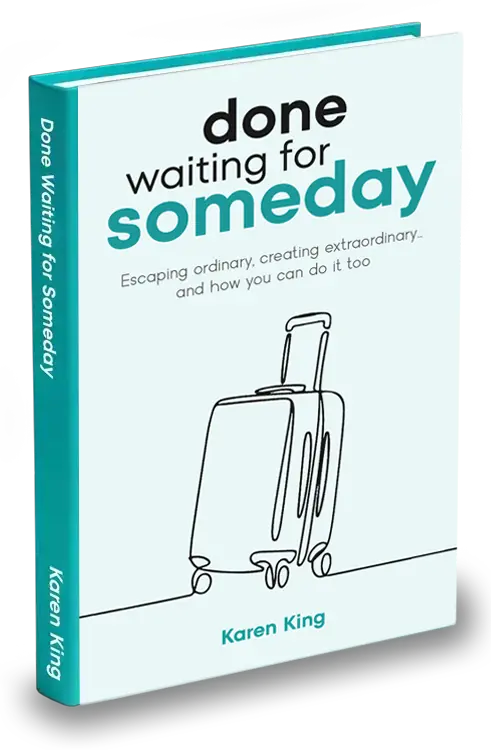
Done Waiting for Someday
The step-by-step path to turning the business you have into the freedom you want.
Get the book →Join The Escape Club
Support, accountability and a room full of people building freedom-first businesses alongside you.
Join the Club →