
Why Traditional Business Advice Doesn't Work for Ambitious Women
You've done the things. You picked a niche, you posted consistently, you bought the course, you followed the launch formula to the letter. And still the money hasn't shown up the way it was promised, and the freedom you built this whole thing for is somehow further away than when you started.
Here's the uncomfortable answer: traditional business advice doesn't work for ambitious women because most of it was never designed for a woman who wants her business to serve her life, not swallow it. It was built to scale revenue at any cost - including yours. You followed good advice. It was just the wrong advice for what you actually want.
I know this because I ran the playbook perfectly once, and it nearly broke me.
What does "traditional business advice" actually mean here?
When I say traditional business advice, I mean the default operating system most of us absorbed without question. Grow at all costs. Hustle harder. Hire fast, scale faster. More offers, more funnels, more launches. Say yes to every client. Reinvest everything back into the machine.
None of that is evil. It's just built on one hidden assumption: that growth is the point, and your time, energy and sanity are fuel to be spent reaching it.
For an ambitious woman who got into business for freedom - time with her kids, room to travel, a say over her own days - that assumption sabotages the entire reason she started.
I learned this the expensive way with a cake business. Cakes by Karen started as an accidental Facebook page when my daughter was eight weeks old. One hundred followers and nine orders in forty-eight hours. I followed every piece of "smart" advice: grow it, take more orders, get the commercial kitchen, chase the numbers.
It worked. Around fifty thousand followers and multiple six figures. It also became a prison - seventy to eighty hour weeks, almost working for free as copycats undercut me. I'd built exactly what the advice told me to build, and I hated my life.

Why does the standard advice backfire for women who want freedom?
Because the metrics are wrong for you. Most business advice optimises for revenue and scale. You're actually optimising for freedom, and those two things pull in opposite directions more often than anyone admits.
Chase revenue the traditional way and you add complexity: more clients, more team, more moving parts, more of your day spoken for. The top line goes up. Your freedom goes down. You end up with a bigger, busier version of the trap you were trying to leave.
There's a measurable gender angle too. Research from the World Economic Forum shows women-led startups receive a tiny fraction of venture funding - the figure has hovered around 2% for years. So the "scale fast, raise money, grow aggressively" model wasn't even built with your access and reality in mind. You're being handed a map drawn for a different journey.
The advice also assumes you want to be the CEO of an ever-growing company. Plenty of ambitious women don't. They want a business that makes good money and gives them their life back. That's not a lack of ambition. It's a different definition of winning - and it's why so many smart women feel like the time freedom that was the whole point keeps slipping out of reach even as the business "succeeds".
The quiet trap: building a business that eats your life
The cruellest part is that it doesn't feel like failure while it's happening. It feels like winning. More orders, more clients, more revenue. You're praised for it. You're "crushing it".
Then one day my three-year-old painted a Mother's Day picture at daycare. The caption the teacher wrote down from her: "My mum's favourite thing to do on the weekend is sleep."
That was the smack in the face. I had the followers and the revenue and the proof that I'd "done it right". I'd also disappeared from my own life. The advice worked. I lost.
If you've built something real and it's eating you alive, you're not doing it wrong. You're doing exactly what you were told - and the instructions led somewhere you never wanted to go. That's the moment to stop adding and start subtracting. A lot of women in this spot are already running on fumes without naming it, which is its own problem worth reading up on if the business has swallowed your whole life.
So what should ambitious women do instead?
Design backwards from your life, not forwards from your revenue goal.
Traditional advice starts with "how big can we make this?" The freedom version starts with "what do I want my actual days to look like, and what business shape delivers that?" Then you reverse-engineer the money from there. It's a completely different question, and it changes every decision after it.
Here's what that looks like in practice:
- Pick a model that doesn't trade time for money. My cake business had a hard ceiling - one of me, so many cake hours. A business built on things you make once and sell many times doesn't. That's the difference between a job you own and a business that frees you.
- Protect your margin before your revenue. A simpler business keeping 80% beats a complex one keeping 20%. Lean isn't small-minded. It's what keeps you free.
- Say no on purpose. Every yes to the wrong client, the wrong offer, the wrong "opportunity" is a no to your freedom. The traditional advice says never turn down money. The freedom version says guard your capacity like it's the asset it is.
- Stop building only on rented land. Facebook once deleted a 13,000-family community I'd built overnight. Gone. Grow your audience on platforms you borrow, but own the relationship - your list, your people, your home base.
This isn't about doing less because you can't handle more. You've already proved you can handle more. It's about aiming all that drive at the right target instead of the one you were handed.

Why does more effort make it worse, not better?
Because ambitious women default to effort. When something isn't working, we do more of it, harder. More posting, more hours, more hustle. It's the most natural response and often the exact wrong one.
If the model is wrong, effort just gets you to the wrong place faster. I was proof of that. I didn't fail at the cake business - I succeeded at it, and the success was the trap. Pouring in more hours would only have deepened the hole.
I'll be honest about my own pattern here. I'm ADHD, diagnosed in 2023, and for years I tried everything and stuck to nothing. I struggled financially for a long time precisely because I kept starting instead of focusing. The freedom only came once I finally pointed my energy in one direction and stopped confusing motion with progress.
"I did the right things in the wrong order" is how I describe it now. The ambition was never the problem. The sequence was. Which is why, when a business stalls, the fix usually isn't more effort - it's a cleaner diagnosis of why you're actually stuck before you touch anything else.
Is it too late to course-correct a business you've already built?
No. And this is the part I most want you to hear, whether you've been at this for a few months or far longer.
You're not starting over. You're holding a running business with real skills, a real audience and real proof that people will pay you. That's an enormous head start. The problem isn't that you built the wrong thing. It's that you built it on advice optimised for someone else's goal.
Changing the goal changes everything downstream without binning what you've made. I didn't throw away the lessons from the cake years. I sold a lifetime of possessions for ten grand, left Australia in January 2016 "deliberately homeless", and have been location-independent ever since - 60-plus countries, 80-plus house sits, world-schooling the kids. The ambition came with me. I just stopped using it to build a prison.
The word Escapepreneur arrived on an early-morning walk in Edinburgh, years after people kept asking me "how do you actually do this?" I accidentally built the antidote to my own brain. You can redesign too - and you don't have to blow up what's already working to do it.
Frequently Asked Questions
Why doesn't traditional business advice work for ambitious women?
Because most of it optimises for growth and revenue at any cost, while an ambitious woman who built her business for freedom is optimising for time, flexibility and a life she controls. Following advice built for someone else's goal gets you a bigger business and a smaller life.
Does ignoring conventional advice mean being less ambitious?
No. It means pointing your ambition at the right target. Wanting a business that makes good money and gives you your time back isn't small thinking - it's a different and often harder definition of success than endless growth.
I've already built my business the "traditional" way. Is it too late to change?
Not at all. You have skills, an audience and proof people will pay you, which is a huge head start. You change the goal and redesign the model around your life, keeping what works instead of starting from zero.
What's the first thing to change when your business isn't giving you freedom?
The question you're building from. Stop asking "how big can this get?" and start asking "what do I want my days to look like, and what business shape delivers that?" Then reverse-engineer the money from there.
You already know a business can give you freedom - you don't need convincing on that. What you need is to stop running a playbook built for someone else's goal. If you want a clear read on where your business is actually stuck and what to change first, start with The Reality Check. It's the honest diagnosis I wish I'd had before I spent years doing the right things in the wrong order.

Karen King, Founder of The Escapepreneur® & ESC Hub
Karen King is the founder of The Escapepreneur® and the woman behind the term. After burning out running a six-figure cake business in Australia, she sold everything, left the country, and spent the last 10 years building a freedom-based business across 60+ countries. On No More Somedays, she writes for the online business owner who is smart, tired, and done with waiting for someday to arrive. Honest, practical, zero hype.
Take the Reality Check
Working hard but going nowhere? Answer 10 quick questions and find out what's really been holding you back — and where to start.
Start My Reality Check →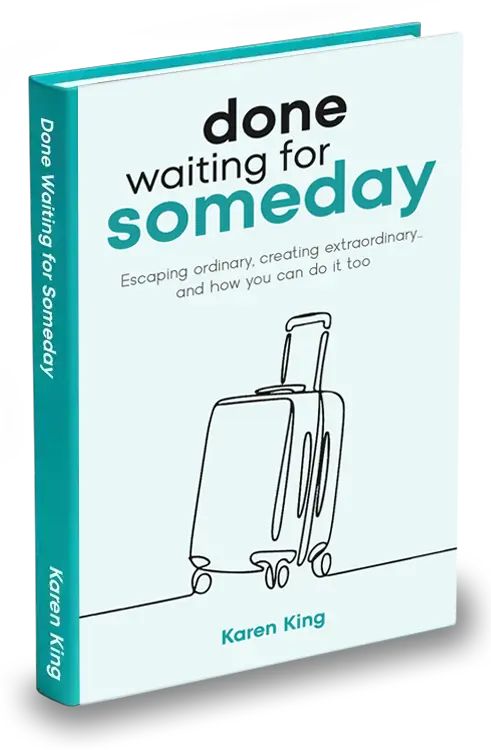
Done Waiting for Someday
The step-by-step path to turning the business you have into the freedom you want.
Get the book →Join The Escape Club
Support, accountability and a room full of people building freedom-first businesses alongside you.
Join the Club →