

Work-Life Integration: Why Balance Failed You (And What Actually Works)
You already built the thing that was supposed to give you your life back. And somehow it took over your life instead. The emails follow you to dinner. You "just check one thing" on a Sunday and lose two hours. The freedom you were promised has turned into a job with a worse boss - you.
Work-life integration is the model that finally made sense to me when balance kept failing. It means designing your business and your life to run inside the same reality instead of fighting each other for the same hours. Not two rival buckets you're forever trying to keep level, but one life where work fits around what matters instead of the other way round.
I'm not going to sell you on why a business can give you freedom. You already know that - it's why you started. The problem isn't belief. The problem is that the business is running and it's eating everything. Let's fix that.
Why work-life balance failed me (and probably you too)
Balance sounds fair. It's a lie dressed up as a goal. It tells you work and life are opposites on a set of scales, and your job is to keep them even. So every hour you spend on the business becomes an hour stolen from your life, and every hour you spend living feels like slacking off.
That's a recipe for guilt in both directions. You're never fully working and never fully off. I lived it hard with my cake business.
Cakes by Karen started by accident on Facebook when my daughter was eight weeks old. A hundred followers and nine orders in the first forty-eight hours. I loved it. It grew to a commercial kitchen and around fifty thousand followers and multiple six figures.
And it became a prison. Seventy and eighty hour weeks. Copycats undercutting me until I was almost working for free. I kept telling myself I'd find "balance" - I just needed to get organised, work smarter, block out family time. It never came, because balance was never the answer to a business built the wrong way.
The smack in the face was a Mother's Day painting from my three-year-old. "My mum's favourite thing to do on the weekend is sleep." That's what balance had actually produced.

What is work-life integration, really?
Work-life integration is a way of structuring your days so business and life share the same space instead of competing for it. Instead of walling off "work time" and "life time," you build a life where the work supports how you want to live - and you stop pretending the two can be neatly separated when you're the whole business.
For a solo founder, separation is a fantasy anyway. You are the marketing, the delivery, the accounts and the brain. Trying to force a corporate 9-to-5 shape onto that is why it never fits.
Here's the difference in plain terms. Balance asks: "Did I split my time evenly today?" Integration asks: "Did today actually look like the life I'm building this business for?" One is about the clock. The other is about the shape of your days.
A Gallup study found that fully remote workers report higher burnout than their in-office peers, largely because work bleeds into everything with no edges. Freedom without structure isn't freedom. It's just work with no walls.
Why your freedom business is consuming everything
When a business runs but drains you, it's almost never a time-management problem. It's a design problem. You've built something that only works when you're inside it, feeding it, every single day.
Look at how it's actually set up:
- Your income depends on you personally delivering - so if you stop, the money stops.
- There are no repeatable systems, so every day starts from scratch.
- You've said yes to too many offers, platforms and "shoulds" and nothing has clear edges.
- You've never decided what the business is for, so it expands to fill every hour you have.
I see people reach for apps and hacks to fix this. It rarely works, because a stuck business isn't a scheduling failure. If that's where you keep landing, this piece on why productivity tools won't fix a stuck business is worth a read - it saved me from a lot of shiny-app disappointment.
The other trap is complexity. More offers, more funnels, more platforms, all in the name of growth. The opposite is usually the move. Before you add one more thing, it's worth learning to simplify the business you already have, because you can't integrate a mess. You can only integrate something clean.

How do you actually build work-life integration?
Integration isn't a mindset shift you do on a Sunday journal. It's structural. You change how the business is built, and the days follow.
Start with the life, then reverse-engineer the business
Most of us do it backwards. We build the business, then try to cram a life into whatever's left. Flip it. Decide what a good ordinary week looks like - school pickup, a morning walk, no work past six, Fridays off, whatever it is for you - and then ask what the business has to look like to make that non-negotiable.
When Cam and I decided to sell everything and travel, we designed the life first. Carry-on luggage only. World-schooling the kids. Then we worked out what income and business shape could sit inside that. Not the reverse.
Build income that doesn't need you sitting at the desk
You can't integrate a business that stops earning the second you step away. This is the real work. Moving from trading hours for money toward things that pay you whether you're at the laptop or on a beach in Panama.
If your revenue is still fully tied to your presence, that's the first thing to change. This breakdown of why your location-independent income streams aren't paying yet gets specific about what to shift, and it's honest about why most people's don't work at first.
Give the work edges
Integration doesn't mean working all the time everywhere. It means deciding where work is allowed to live. For me that's blocks of deep focus when my ADHD brain is actually firing, and then genuinely closing it. The phone goes in another room. No "quick checks."
Edges are what stop integration from collapsing back into the always-on mess you're trying to leave.
Is work-life integration worth it, or just a rebrand of balance?
Fair question. "Work-life integration" gets thrown around by corporate types who really mean "answer Slack at midnight." That's not what I'm talking about.
Real integration is worth it because it stops the tug-of-war. You're not stealing from your kids to serve a client, and you're not stealing from clients to be present with your kids. The two live in one honest life.
I've now lived location-independent for years across more than sixty countries. Turkey for two hundred and fifty dollars a month in Fethiye, skiing in Bulgaria, over eighty house sits that saved us more than a quarter of a million dollars. None of that came from balancing better. It came from building a business that fits the life instead of swallowing it.
Here's the honest part. I did the right things in the wrong order, and I struggled financially for years before it clicked. The freedom came once I finally focused and stopped bolting more onto a broken structure. Integration is worth it, but only if you're willing to change the design, not just your calendar.

What to do differently starting now
If work is consuming everything, you don't need another productivity system. You need to change three things.
- Decide what the business is for. Write down the life it's meant to fund and the hours it's allowed to take. If it's currently breaking those rules, that's your signal.
- Cut before you add. Find the offers, platforms and clients that cost more energy than they return, and let them go. Clean first.
- Move one income stream off your back. Package what you already know so it earns without your live presence, even a little. That's the seed of a business that can hold a life.
None of this is fast. But it's the difference between a business that owns you and one you can actually live inside. If you're already burnt out from carrying it all, this piece on why you're running on empty and what actually fixes it is the one I'd read next.
Frequently Asked Questions
What is the difference between work-life balance and work-life integration?
Balance treats work and life as opposites you keep even on a set of scales, which creates guilt in both directions. Integration builds one life where the work supports how you want to live, instead of competing with it for the same hours.
Is work-life integration bad for boundaries?
Only if you do it wrong. Real integration still has clear edges - set times and places where work is and isn't allowed. Without those edges it just becomes being on call all the time, which is the opposite of the point.
How do I stop my business from consuming all my time?
Change the design, not the schedule. Decide what the business is for, cut the offers and platforms that drain more than they return, and move at least one income stream off your personal, live presence so the business earns without you sitting at it.
Does work-life integration work for solo founders and freelancers?
It works especially well for them, because true separation of work and life is a fantasy when you are the entire business. Integration accepts that reality and structures your days around the life you actually want.
You already believe a business can give you your life back - you've just been trying to balance your way there when the real fix is in how the thing is built. If you want to see exactly where yours is stuck and what to change first, start with The Reality Check. It's the honest look at what's not working, so the next version of your business actually fits the life you started it for.

Karen King, Founder of The Escapepreneur® & ESC Hub
Karen King is the founder of The Escapepreneur® and the woman behind the term. After burning out running a six-figure cake business in Australia, she sold everything, left the country, and spent the last 10 years building a freedom-based business across 60+ countries. On No More Somedays, she writes for the online business owner who is smart, tired, and done with waiting for someday to arrive. Honest, practical, zero hype.
Take the Reality Check
Working hard but going nowhere? Answer 10 quick questions and find out what's really been holding you back — and where to start.
Start My Reality Check →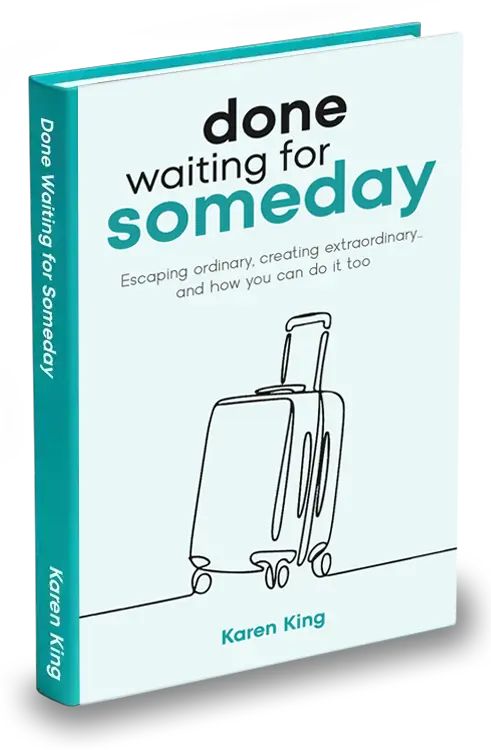
Done Waiting for Someday
The step-by-step path to turning the business you have into the freedom you want.
Get the book →Join The Escape Club
Support, accountability and a room full of people building freedom-first businesses alongside you.
Join the Club →