
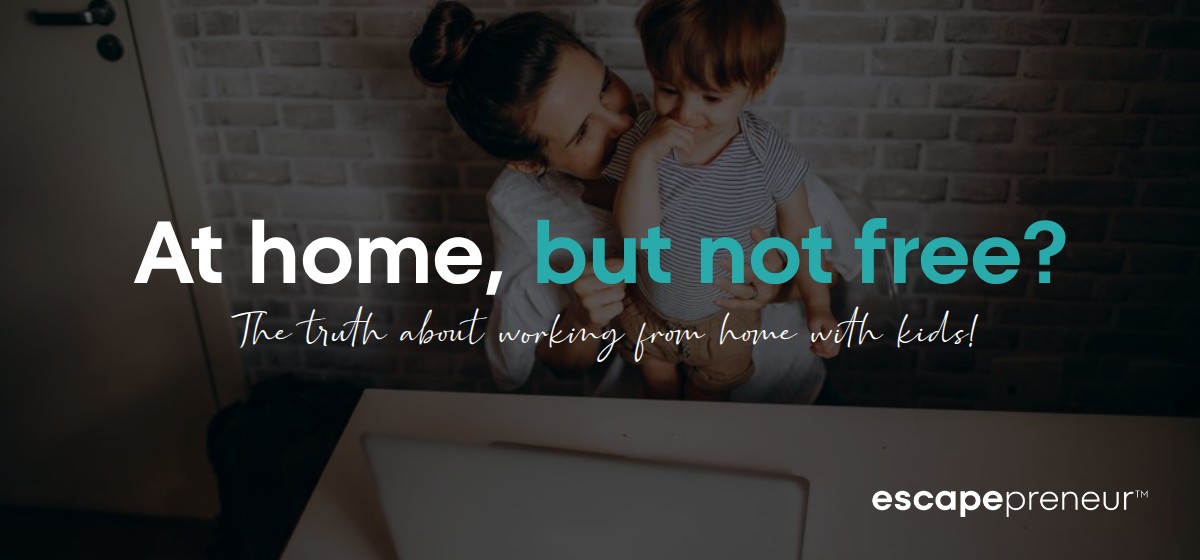
Work From Home With Kids: Why Yours Feels Impossible (And What Actually Fixes It)
You already left the office. You built the thing so you could be home, so you wouldn't miss the school pickup, so your life would feel like yours. And yet here you are, laptop open at 9pm because that was the only quiet you got all day, wondering why the freedom you designed feels exactly like the trap you left.
If you want to work from home with kids and make real money and actually enjoy the kids while you're at it, the honest answer is this: it doesn't work when your business and your family are fighting for the same hours. It works when you stop trying to do both at once and build a business that runs in blocks, not around constant interruption.
I'm not guessing here. I ran a cake business from home when my daughter was a newborn. I know exactly what it feels like to have a baby on your hip and a deadline in your face and the growing suspicion that you've built yourself a job you can never clock off from.
Why does working from home with kids feel so much harder than it should?
Because you're doing two jobs in one room and pretending they're one job. Parenting is not a background task. Neither is running a business. When you stack them, both suffer, and you feel like you're failing at the very thing you gave up so much to do.
My cake business started as an accident. I set up a Facebook page when my daughter was eight weeks old and had 100 followers and nine orders inside 48 hours. I loved it. Then it grew into a commercial kitchen, around 50,000 followers, multiple six figures, and 70 to 80 hour weeks.
The freedom I thought I was building quietly became a prison. Copycats undercut me until I was almost working for free. I was home, technically. I was also completely gone.
The turning point was a Mother's Day painting my three-year-old brought home. In it, she'd written that my favourite thing to do on the weekend was sleep. That was a smack in the face I couldn't unsee.
So if you feel like the "work from home" dream you sold yourself has curdled into resentment, you're not weak and you're not doing it wrong on purpose. You've most likely built a model that structurally cannot give you what you wanted.

What's actually broken: your model, not your discipline
Women who are 5 or 10 years into a freedom business rarely need another productivity hack. You've read the books. You time-block. You've tried the 5am starts. The problem is deeper than your calendar.
Most home businesses that trap their owners share the same faults. They trade time directly for money, so the only way to earn more is to work more. They rely on you being available, so you can never fully step away. And they were designed for the version of you who had energy to burn, not the one holding this life together.
Research backs up how heavy this load runs. According to the Pew Research Center, mothers still spend significantly more time on childcare than fathers even in households where both parents work full time. You are not imagining the imbalance. You're living inside it while trying to run a business on top.
This is why "just be more organised" is useless advice. You can't out-organise a business model that was built to consume you. If you're constantly starting things and never quite finishing them, it's worth looking at whether your unfinished projects are costing you more than you think - because scattered energy and a broken model feed each other.
How do you actually work from home with kids and make money?
You stop building a business that needs you present every hour and start building one that produces value in blocks of focused time. Two hours of deep, uninterrupted work beats eight hours of fragmented, guilt-soaked multitasking. Every single time.
Here's what that looks like in practice.
1. Pick one offer and stop diluting yourself
The mothers I see burning out are usually running three half-businesses. Coaching, plus a course, plus some freelance work, plus a bit of Etsy. Each one demands setup, marketing and mental space, and none of them gets enough of you to actually pay off.
I know this pattern intimately. I was diagnosed with ADHD in 2023, and the truth is I struggled financially for years because I never stuck to one thing. The freedom only arrived once I finally focused. If you're spread thin, start with how to pick one thing when you're stuck doing everything.
2. Build in blocks, not around interruptions
Trying to work while a toddler is awake and in the room is not working. It's damage control. Decide when you actually work - during school, during a set childcare block, during nap or after bedtime - and protect those hours like they're a client meeting, because they are.
Outside those blocks, be a parent. Not a parent half-checking email. A parent. The guilt lifts when the lines are clear, because you're not perpetually failing at both at once.
3. Move away from selling only your hours
If you get paid only when you're actively working, kids will always feel like the thing stealing your income. Shift toward offers that don't require you present in real time: a group programme instead of only one-to-ones, a product, a retainer with clear boundaries, something that keeps earning while you're at the park.
This is the difference between a job you do from home and a business that supports your life. If you're a coach specifically, look at why your coaching business isn't paying you what it should yet - the fix is almost always in the model, not the effort.

What kids actually need (and it's not you at 100% availability)
We tell ourselves that being physically present every second is the goal. I don't believe that anymore, and my kids taught me why.
My daughter Sienna was world-schooled and running the front of house at a boutique hotel by the age of 10. She didn't learn that from me hovering. She learned it from watching me build things, take risks, say yes before I felt ready, and treat the world as something you're allowed to shape.
I grew up in an Air Force family and lived in 30 houses by the time I was 21. Restlessness is in my bones. What I've come to see is that children raised around a parent doing meaningful work - visibly, unapologetically - absorb something no amount of undivided attention can teach. They learn that a life can be built to your own design.
So the model isn't "hide the business from the kids." It's "run the business well enough that it takes fewer hours and better hours, and let them see you do it."
Is it worth restructuring instead of pushing harder?
Yes. Pushing harder on a broken model just gets you more efficiently exhausted. The women who break out of the trap are the ones who stop asking "how do I fit more in" and start asking "why does this need so much of me in the first place."
When I finally asked that question about the cake business, the answer was uncomfortable. It needed all of me because I'd built it to. Handmade, custom, undercut by copycats, entirely dependent on my hands and my hours. There was no version of that business that gave me my weekends back. The whole thing had to change.
We sold a lifetime of possessions for about $10,000 and left Australia in January 2016, deliberately homeless. Since then we've lived in more than 60 countries, world-schooled the kids, and saved over $250,000 through 80-plus house sits. None of that came from working harder. It came from rebuilding around the life I actually wanted.
You don't have to sell everything and move abroad. That was my version. But you do have to be willing to change the structure rather than just tightening your grip on it. If you're staring down a bigger reinvention, making a real change when you already know you want more is a good place to sit with what's next.
Frequently Asked Questions
How many hours a day can you realistically work from home with young kids?
Most mothers of young children get two to four hours of genuinely focused work a day, usually in blocks during childcare, school or naps. The goal is to make those hours high-value rather than trying to stretch low-quality work across the whole day.
What's the best type of business to run from home with kids?
One that doesn't depend on you being available in real time. Group programmes, digital products, retainers and productised services all earn without trading every dollar for an hour, which is exactly what makes them survivable around family life.
How do I stop feeling guilty working while my kids are around?
Draw clear lines. When you're working, work; when you're with them, be fully there. The guilt usually comes from doing both badly at the same time, not from working itself. Kids also benefit from seeing a parent build meaningful work.
I'm already years into my business and it's still not working. Is it too late to fix it?
No. Being 5 to 10 years in usually means you have an audience, skills and proof - you're not starting cold. The issue is almost always the model, not your ability, and models can be rebuilt without starting from zero.
You've already done the hard part. You chose freedom over the default, you built something real, and you've kept going through the years where it wasn't paying you what it should. The next move isn't more hustle - it's an honest look at where your model is fighting your life so you can rebuild the part that's stuck. Start with The Reality Check to pinpoint exactly what's holding your business back, and let this be the year working from home with your kids finally feels like the freedom you meant it to be.

Karen King — Founder, The Escapepreneur™ & ESC Hub
Karen King is the founder of The Escapepreneur™ and the woman behind the term. After burning out running a six-figure cake business in Australia, she sold everything, left the country, and spent the last 10 years building a freedom-based business across 60+ countries. On No More Somedays, she writes for the online business owner who is smart, tired, and quietly done with waiting for someday to arrive. Honest, practical, zero hype.
Take the Reality Check
Working hard but going nowhere? Answer 10 quick questions and find out what's really been holding you back — and where to start.
Start My Reality Check →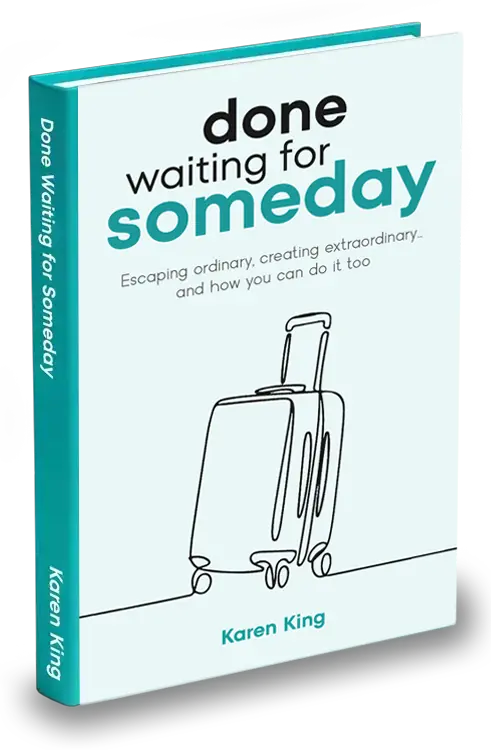
Done Waiting for Someday
The step-by-step path to turning the business you have into the freedom you want.
Get the book →Join The Escape Club
Support, accountability and a room full of people building freedom-first businesses alongside you.
Join the Club →