

Travel Vision Board: How to Make One That Actually Moves You Forward
You've made vision boards before. Maybe one is sitting on your phone right now, a grid of beaches and villas you saved two years ago and haven't looked at since. And here you are, still working too many hours, still not free in the way you pictured when you started this whole thing.
A travel vision board only works when it stops being a mood board and starts being a planning tool. That's the difference between a wall of pretty pictures and something that actually pulls you toward the life you said you wanted. I've used one for years, and I'm currently writing this from a place I put on a board long before I could afford to get here.
If you're five or ten years into building a freedom business and the freedom part still hasn't shown up, this isn't about wanting it more. It's about wiring the want to a decision.
What Is a Travel Vision Board, Really?
A travel vision board is a visual collection of the places you want to go and the way you want to live while you're there, organised so it informs real decisions about your time, money and business. It is not a wish list. It's a filter.
Most people treat it as decoration. They pin sunsets and infinity pools, feel good for an afternoon, and change nothing about how they run their days. That version doesn't move you, because nothing is attached to it.
The useful version answers a harder question: what would my business need to look like for this to be normal, not a once-a-year reward? When you build it that way, the board stops being a fantasy and starts being a brief.
I've travelled to over 60 countries while running my business, and almost none of it happened by accident. The trips that happened were the ones I planned backwards from. The ones that stayed "someday" were the ones I only ever admired.

Why Your Last Vision Board Did Nothing
Here's the uncomfortable part. If you've been at this a while and your vision board hasn't shifted anything, the board isn't the problem. The disconnect between the board and your calendar is.
Three things usually go wrong:
- It's all destination, no design. You pinned where you want to be but nothing about how you'd work, earn or live while there.
- It's a feeling, not a target. "Freedom" and "travel more" can't be scheduled. "Two months in Portugal next spring, working three days a week" can.
- You never looked at it again. A board you check once a year is a screensaver. A board you act from is a plan.
There's research behind why the specific version works. People who write down vivid goals and review them regularly are significantly more likely to achieve them, according to a widely cited study from Dominican University of California. The board isn't magic. The repetition and specificity are doing the work.
I go deeper into the mechanics of this in my post on how to create a vision board that works when you do it right. The short version: vague boards produce vague results, every time.
How Do You Make a Travel Vision Board That Drives Action?
Start with the trips, but don't stop there. The mistake is treating the destination as the goal. The destination is the headline. The real content is the life around it.
For each place you add, force yourself to answer three things:
- When. A rough season and year, not "one day". This is the part most people skip, and it's the part that turns a wish into a deadline.
- How you'll work. Are you offline? Working mornings only? Running the business from a laptop two days a week? This forces you to design the business to support the trip.
- What it costs. Not just flights and accommodation. The income your business needs to be producing for that month to feel easy, not stressful.
When you do this for even five destinations, something shifts. You stop looking at a collage and start looking at a set of requirements. And requirements you can plan toward.
This is the same backwards-planning I used to build the rest of my life, which I wrote about in how I built my dream life from scratch. You don't start from where you are. You start from the picture and work back.
Travel Vision Board Ideas That Go Beyond Pretty Pictures
If you want travel vision board ideas that actually do something, build it in layers instead of one flat wall of images. Here's how I'd structure it.
Layer 1: The non-negotiable trips
Pick three to five places you genuinely intend to go in the next two years. Not the dream list of 40. The real shortlist. Specificity is what makes a board work, and you can't be specific about 40 places at once.
Layer 2: The way you want to travel
This is the layer people miss. Slow travel or fast? Solo, with a partner, with kids? Boutique hotels or a base you rent for a month? How you travel changes what your business has to fund and how it has to run without you.
Layer 3: The business behind it
Add the numbers and the model. Monthly income target. Hours per week you're willing to work while away. Whether your offers can run while you're in a different time zone. This layer is what separates a travel vision board from a holiday Pinterest board.
Layer 4: The proof
Add one or two places you've already been because of this business. Evidence that it works changes how you relate to the rest of the board. It stops being hope and becomes a pattern you're extending.
I keep mine as the background on my laptop, so I see it multiple times a day. I don't sit and study it. It's just always there. And often, without me realising it, things on it have come true.
What If You're Stuck and the Board Just Makes You Feel Behind?
This is the real situation for a lot of women I talk to. They've been building for years. They know what they want. The vision board doesn't inspire them anymore - it stings, because the gap between the pictures and the bank account feels wider every time they look.
If that's you, the board isn't the issue and neither is your ambition. The business model underneath it is the issue. You can't travel two months a year on a business that needs you present every single day to make money.
So before you add another destination, get honest about why the current setup can't deliver the board you already have. That diagnosis matters more than another round of pinning. My Reality Check walks you through exactly where an established-but-stuck business tends to break down, so you're fixing the right thing instead of working harder on the wrong one.
Sometimes the honest answer is that you've outgrown the thing you built. That's not failure. That's the same instinct that made you start, showing up again. I wrote about that exact feeling in making a move when you already know you want more.
How to Use a Travel Vision Board Every Single Week
A board that lives in a drawer does nothing. A board you use weekly quietly changes your decisions. Here's the routine I keep.
Once a week, I look at the board and ask one question: did anything I did this week move me closer to one of these trips? If the answer is no for several weeks running, that's data. It tells me my time is going to maintenance, not movement.
Then I pick the nearest trip on the board and ask what the next concrete step is. Booking a date. Building an offer that can run while I'm away. Saying no to a client commitment that would block the dates. Small, specific, this-week steps.
That's the whole trick. The travel vision board points at the destination. The weekly check turns it into a sequence of decisions. Without the second part, the first part is wallpaper.
Frequently Asked Questions
Do travel vision boards actually work?
They work when they're specific and reviewed often, and they don't when they're a one-time collage you never look at again. Research from Dominican University found that writing down vivid goals and reviewing them regularly meaningfully increases the chance of achieving them. The board is a prompt, not a spell - the specificity and repetition do the work.
What should go on a travel vision board?
The places you genuinely plan to go in the next year or two, plus how you want to travel, when, and what your business needs to earn to make each trip easy. Add one or two trips you've already taken because of your business, as proof the model works.
Digital or physical travel vision board - which is better?
Whichever one you'll actually see often. I keep mine as my laptop background so it's in front of me multiple times a day and I can update it in minutes. A physical board only works if it's somewhere you can't avoid it.
How often should I update my travel vision board?
Every few months, and review it weekly. The review is the part that changes your behaviour - you're checking whether your week moved you toward a trip, and adjusting if it didn't.
Why does my vision board make me feel behind instead of motivated?
Usually because the gap between the board and your reality is about the business model, not your effort. If your business needs you present every day, it can't fund the freedom on the board no matter how hard you work. Fixing the model is what closes the gap.
Your travel vision board is already telling you the truth about the life you want. The question now is whether the business under it can carry the weight. If the pictures have been the same for years and the trips haven't followed, that's the signal to stop adding destinations and start looking at the model. My Reality Check is the honest place to begin - it shows you where a stuck business is leaking your time and freedom, so the next place you pin becomes a plan instead of a wish.

Karen King — Founder, The Escapepreneur™ & ESC Hub
Karen King is the founder of The Escapepreneur™ and the woman behind the term. After burning out running a six-figure cake business in Australia, she sold everything, left the country, and spent the last 10 years building a freedom-based business across 60+ countries. On No More Somedays, she writes for the online business owner who is smart, tired, and quietly done with waiting for someday to arrive. Honest, practical, zero hype.
Take the Reality Check
Working hard but going nowhere? Answer 10 quick questions and find out what's really been holding you back — and where to start.
Start My Reality Check →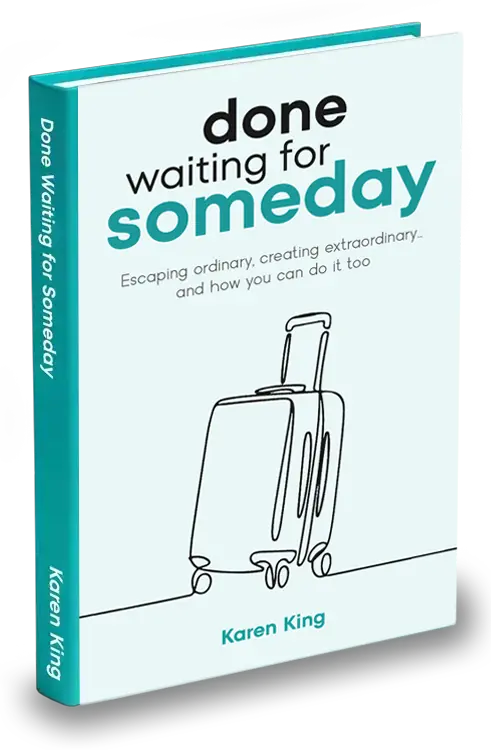
Done Waiting for Someday
The step-by-step path to turning the business you have into the freedom you want.
Get the book →Join The Escape Club
Support, accountability and a room full of people building freedom-first businesses alongside you.
Join the Club →