

Write for a Digital Nomad: How to Turn Your Words Into a Location-Free Income
You already know you want the freedom. You're not here to be sold on the laptop life or the idea of working from a beach in Bali. You've been at this for a few years, and somewhere along the way the income stalled, the freedom got smaller, and you started wondering if you picked the wrong thing.
If you can write, you have one of the cleanest paths back to that freedom. When you write for a digital nomad audience - or write as one yourself - you turn a skill you already have into income that travels with you. No clock, no commute, no fixed address required.
I built my own location-free business on the back of words. I've written from cafes in Lisbon, a flat in Mexico City, and a too-hot room in Thailand with the fan on full. The work moved with me. That's the point I want to make here, and I want to make it useful for someone who is past the beginner stage.
What does it mean to write for a digital nomad?
To write for a digital nomad means producing written work - articles, copy, ghostwriting, email sequences, course content - that you can deliver from anywhere with a laptop and wifi, for clients or an audience who value words over your physical presence. It's writing as a portable income, not a desk job that happens to be remote.
There are two versions of this, and they're easy to confuse. One is writing for digital nomads and remote founders as your client base. The other is being the nomad yourself and writing for whoever pays well. You can do both. The mechanics overlap, and the freedom is the same either way.
The reason this matters for you specifically: you've already proven you can do hard things. You've run a business. You know how to deliver. The gap is usually not skill. It's that the offer got muddy, the pricing got stuck, or the work got too tied to one platform that stopped sending traffic.

Why writing is still one of the best location-free skills
Writing scales in a way few service skills do. You can charge by the hour, by the project, by the retainer, or you can write once and sell it a thousand times. That range is rare.
The demand is real, not theoretical. Remote work isn't a trend that's fading - McKinsey research found that 58% of Americans can work from home at least one day a week, and that whole economy runs on content, copy, and clear communication. Someone has to write all of it.
Here's the part that gets missed. The bottleneck for most experienced writers isn't getting clients. It's getting clients who pay enough that you only need a few of them. Five clients at the wrong rate is a job with extra steps. Five clients at the right rate is freedom.
I learned this the slow way. Early on I said yes to everything and undercharged out of fear. The work filled my days and my bank account stayed flat. The fix wasn't more clients. It was fewer, better ones - and the nerve to ask for the rate that made the maths work.
How do you start writing for a digital nomad income?
Since you're not a beginner, I'll skip the "build a portfolio" speech you've heard. Let's go where the actual movement happens.
Pick a lane that pays, not just one you like
General "I write anything" is the lowest-paid position there is. The writers earning real money have a lane: SaaS email, finance ghostwriting, health content, conversion copy for course creators. Pick something with budget and pick something you can speak about with some authority.
If you've spent years in a particular industry, that's your unfair advantage. A former nurse who writes health content beats a generalist every time. A former accountant who writes for fintech does too. Your past career isn't baggage, it's positioning.
Build one offer, not a menu
Stuck writers tend to offer everything. It feels safer. It isn't. One clear offer at one clear price is easier to sell and easier to deliver.
Think: "I write monthly email sequences for course creators, $2,000 a month." That's a sentence a client can say yes to. "I do copywriting and content and social and maybe websites" is a sentence that makes people close the tab.
Price for the life you actually want
Work backwards from the income you need, then divide by the number of clients you're willing to carry. If you want to write for a digital nomad lifestyle that involves slow travel and real days off, you cannot have twenty clients. You need a handful paying well.
This is the same maths I walk through when people tell me they did a career change at 40 and still feel stuck. The freedom math has to come first, before the hustle.
The mistakes that keep experienced writers stuck
You're probably not stuck because you can't write. You're stuck for one of these reasons, and I've made most of them myself.
- You're trading time for money with no way to multiply it. Every dollar requires another hour. There's a ceiling, and you hit it.
- You depend on one platform. One algorithm change or one client leaving and the income wobbles. Concentration is the risk nobody talks about.
- You never raised your prices. You're charging 2019 rates for 2024 work. The market moved, you didn't.
- You build for clients but not for yourself. All your best writing goes to other people's brands while your own stays empty.
That last one is the quiet killer. You can write beautifully for clients and have nothing of your own that compounds. The fix is to spend some of your writing on assets you own - an email list, a body of articles, a small product. That's how the income stops being rented.
When I finally started writing for my own business instead of only for clients, the whole thing changed. It took longer to pay off, but it paid off in something a client retainer never can: an audience that's mine.

Turning writing into a real location-free business
A single skill is a job. A business is a system around that skill. The shift from one to the other is where freedom actually lives.
Start by separating your income into two streams. The first is client work - it pays now and funds the rest. The second is owned assets - content, list, products - that pay later and pay repeatedly. You feed the second with the profits and the time the first one buys you.
This is the same structure behind how I built my dream life from scratch. It wasn't one big move. It was using paid work to buy the time to build the thing that doesn't need me sitting at the keyboard every day.
What does the day-to-day actually look like?
Mornings on client deliverables, afternoons on your own content, evenings free. Or three deep work days and the rest of the week loose. The shape is yours. That flexibility is the whole reason you choose to write for a digital nomad life over a salaried remote role.
The trap is letting client work expand to fill every hour. It will if you let it. Protect the time for your own assets like it's a paying client, because it's the one that eventually pays the most.
Where the writing leads next
For a lot of writers, the words become the front door to something bigger - a course, a membership, a consulting offer. The audience you build through writing is the warm list you sell the bigger thing to later.
This is roughly the path of an escapepreneur - someone who builds a business around the life they want rather than the other way round. Writing is one of the simplest starting points because the barrier is so low. You already have the skill. You need the structure and the nerve.
Is writing for a digital nomad lifestyle actually worth it?
Honestly? Yes, but only if you treat it like a business and not a freelance gig that you hope grows by accident.
The writers who are still struggling five years in are usually running the same week on repeat - new client, deliver, get paid, repeat, nothing built that multiplies their effort. The ones with real freedom made deliberate choices: a lane, a high enough rate, and assets they own.
You've already done the hard part, which is deciding you want this life. What's left is fixing the mechanics. That's a much smaller problem than the one you solved when you first walked away from the standard path.
Frequently Asked Questions
Do I need a niche to write for a digital nomad income?
You don't strictly need one, but a niche lets you charge more and win work faster. Pick a lane tied to an industry you already understand, and you'll out-position generalists who compete only on price.
How much can you earn writing as a digital nomad?
It ranges widely, from a few hundred a month to six figures a year. The difference is almost never talent - it's positioning, pricing, and whether you've built any owned assets alongside client work.
Is it too late to start if I'm already a few years into a stuck business?
No. Years in usually means you have skills, contacts, and proof that a beginner doesn't. The fix is rarely starting over - it's tightening your offer, raising your rates, and adding ways to multiply your effort.
What's the difference between freelance writing and a writing business?
Freelance writing trades your time for money one project at a time. A writing business adds systems and owned assets - a list, content, products - so income compounds instead of resetting every month.
You don't need a new dream. You need the version of this that finally pays you in money and time, and that usually means a clear-eyed look at exactly where the current setup is leaking. If you're a few years in and stuck, start with The Reality Check - it's built to pinpoint what's not working so you can fix the mechanics instead of starting from zero. Writing can absolutely carry the freedom-based life you decided on. The work now is making it carry the income too.

Karen King — Founder, The Escapepreneur™ & ESC Hub
Karen King is the founder of The Escapepreneur™ and the woman behind the term. After burning out running a six-figure cake business in Australia, she sold everything, left the country, and spent the last 10 years building a freedom-based business across 60+ countries. On No More Somedays, she writes for the online business owner who is smart, tired, and quietly done with waiting for someday to arrive. Honest, practical, zero hype.
Take the Reality Check
Working hard but going nowhere? Answer 10 quick questions and find out what's really been holding you back — and where to start.
Start My Reality Check →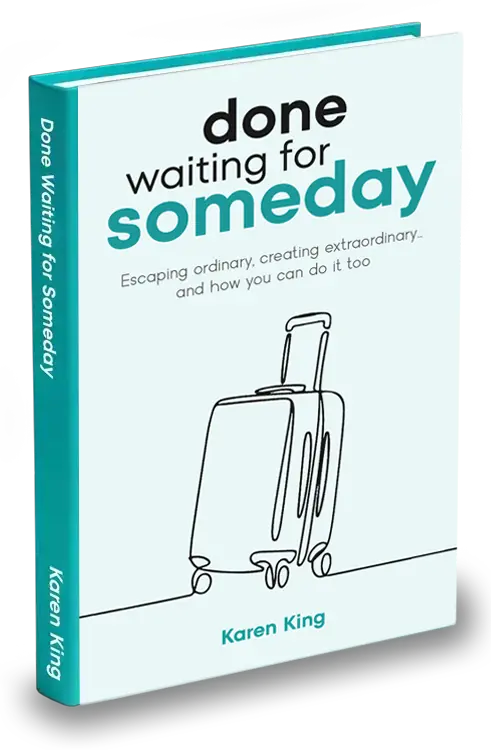
Done Waiting for Someday
The step-by-step path to turning the business you have into the freedom you want.
Get the book →Join The Escape Club
Support, accountability and a room full of people building freedom-first businesses alongside you.
Join the Club →